
I Was Wrong About Undertone
I rail on brands constantly for how they categorize their foundation ranges. They are not consistent or accurate. But there is one thing they do right, one thing that I have been doing wrong.

I am always honest about how color theory continues to teach me. The more I study it, the more I grow as an artist. The depth of understanding and being able to see color in skin, color in color just gets bigger and bigger for me as I move through this journey. I have been focused on color theory in skin now for 9 years and continue to find new ways to look at it, talk and teach about it and use it.
I just made a “new” discovery.
I say it is new because I suspect others have thought this way. I’m just realizing it and seeing that how I approached undertone and foundation colors was not right.
So time for me to explain and maybe ….apologize???
Skin and Undertone
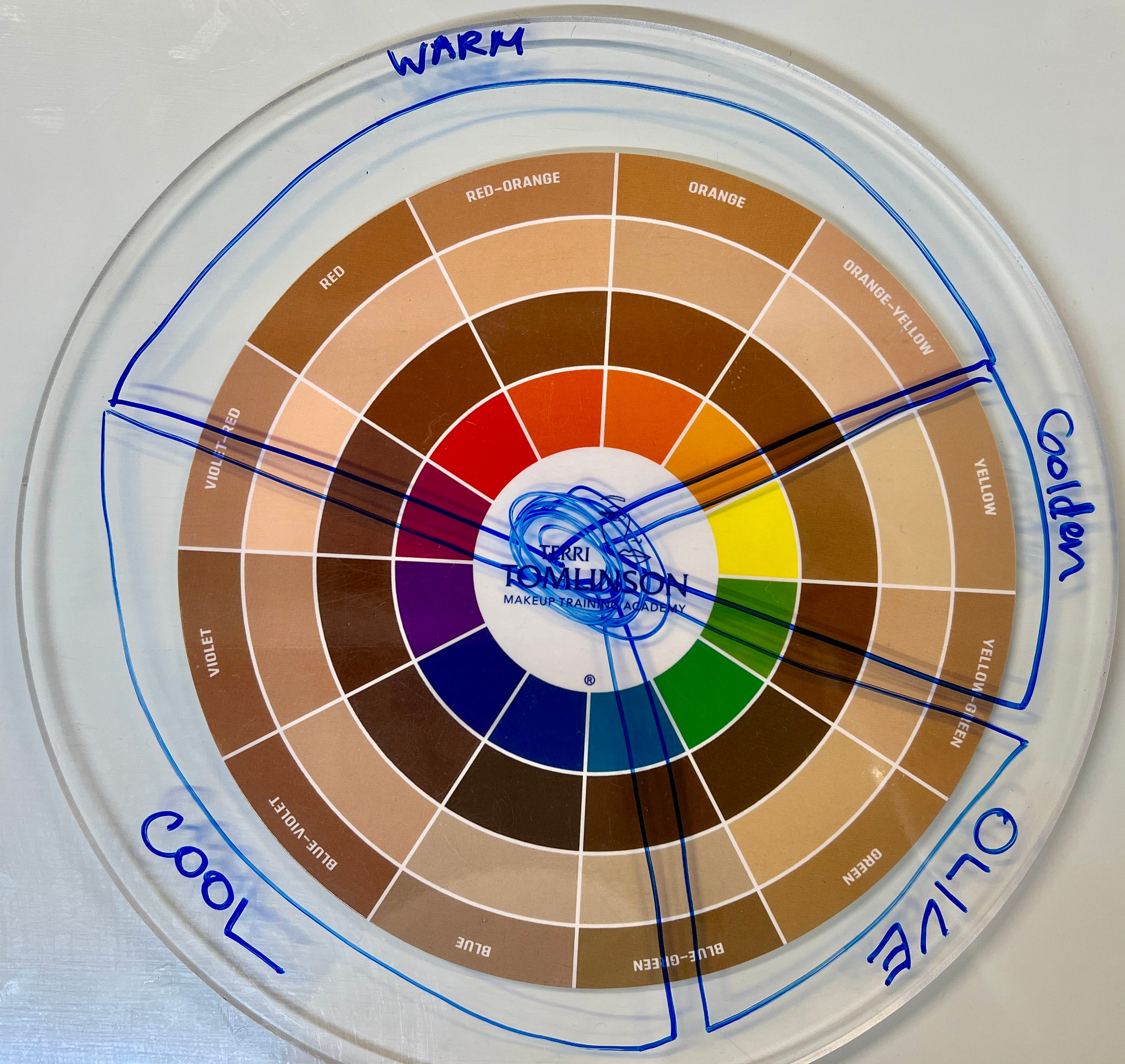
All skins have a specific undertone that can be determined by examination. I created The Flesh Tone Color Wheel® and The Flesh Tone Fan™ for this. They are both tools that show the 12 possible undertones that can exist in skin in a light, medium and deep sample. The tools help to train the eye to see color in skin and neutral and to use as a guide.
Because I have worked so closely with these tools over the years, created education around them and studied them, I have also fallen into a trap. I see the 12 possibilities of undertone in skin pretty clearly and assumed that foundations would all fall into one of them, regardless of their depth.
So when I look at foundation ranges I expect each color to sit in 1 of the 12 undertones. It made sense in my brain. I even have my own foundation line categorized by its specific undertone.
But I’m wrong.


Makeup and Undertone
I have always been irritated when brands categorize their foundations incorrectly. Most traditionally will do groupings for Warm, Cool and Neutral. But many have issues. The problem isn’t just that this is a vague categorization, the problem is that the foundations are mislabeled most of the time.
They might have “warms” that are olive/yellow, “cools” that are pink and “neutrals” that are blue/gray. There is so much inconsistency in how brands classify the tones of their makeup as well as a lack of understanding their own colors that it is a crapshoot anytime you go to find a color.
So I started looking at foundations in the market according to where they would sit on my wheel or fan. And in doing so I made the assumption that a foundation would have a single undertone.
I was wrong.
The Power of Neutral
In my quest to discover specific undertones within foundation product I forgot about how powerful Neutral is.
You see, skin is neutral. Our skin is a mix of all colors and the blend of all of those colors creates a neutralized tone. And in order to create foundation colors, manufactures use a mix of red, yellow and black to make neutrals that are universal to many skins. This is why they categorize colors as warm or cool, rather than with specific undertones. Because the neutrals match a wider range, they match tones.
Foundations have all colors in them the way skin does. And because of that they will adapt to various tones of skins, as opposed to undertone. This is why my HD Fluid #2 Cream, which I call a yellow-orange, can match a violet-red. As long as that violet-red skin has come warmth to it, my #2 will be perfect.
Foundation ranges are created towards a warm tone, a cool tone, olive tone, ruby tone…so many names can be used. But each tone can encompass multiple undertones.
See, the undertone is the color within the color. The tone is the color’s base.


Tone vs. Undertone
A foundation might have a warm base (meaning in my color theory brain, something that runs between red and yellow) so might match undertones ranging from yellow-orange to red. A cool tone might match red-violet’s into blue undertones. An olive tone might match yellow-to-green undertones.
Get it?
So, for another example. I have a 1, 1.5 and 2 in my HD Fluid range and all are about the same depth. They all sit in the 1-2 range of depth. #1 is warm and a yellow undertone. It works best on super light skins that sit in the warm undertones between yellow and violet-red. #1.5 would be considered more “neutral” (yes, I still hate how we use this word) and a yellow-green undertone, but it does well on any skin that is olive or very cool. I have violet-reds that don’t show a lot of pink that love it. The #2 is very peachy and warm in tone. It is best on level 2 (depth) skins that sit between undertones yellow-orange to the rosier violet-reds.
There is overlap because the foundations adapt to the skin as you blend them in. They are made to match a wider range of undertones.
In Conclusion
Now that I see this I have to re-test my foundations and give them a wider range. I have been limiting these neutral blends based on my need to see specific color in color. My eyes are open to a new thought process.
I know that this is pretty technical. If you are a pro I hope that you can follow it and have some insight. If you are a consumer, this is great information for you as well. Think about how you can approach your foundation shopping now. Know if you are warm or cool, know what that is supposed to look like (because so many brands have it wrong) and know your depth.
Those few things give the consumer so much power when shopping for makeup.
Shall we explore this further? If so, let me know.
